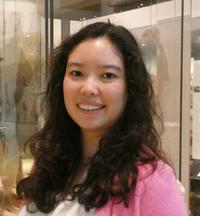
Akari Goda-Maurezzutt attended undergrad in Oakland, California, where she graduated with a BA in Chemistry and a BA in Art History. She then trained under an art conservator before beginning an MS in Science for the Conservation-Restoration of Cultural Heritage at the University of Bologna.
Akari has always loved the interplay between the arts and the sciences and thus joined the UKRI-ERC funded Horsepower project as a DPhil student. Horsepower, which aims to understand the development and interactions between the Central Plains and the Steppe leading to the Xiongnu empire and the Qin dynasty, was a perfect fit due to its interdisciplinary nature, her interest in cross-cultural interactions, and her previous experience working with and analysing museum collections.
Akari’s research focuses on the bronze collection within the British Museum. While she has always loved researching objects using scientific analysis, this project has helped her unearth a passion for collection history and provenance research as well. She hopes to continue exploring museum collections and learning how to rebuild the biographies of cultural heritage.
DPhil topic
Akari Goda-Maurezzutt’s DPhil revolves around researching the bronzes within the British Museum’s Early China Collection. The objects in question – primarily bronze plaques and personal ornaments – have not previously been analysed and are believed to originate largely from China or Inner Mongolia. Within the larger scope of Horsepower, she aims to answer the central question: how did the cultures in the Steppe and China interact during the Late Bronze Age and Early Iron Age? To accomplish this, the following secondary questions will be answered: One, how can bronze objects from the Steppe and China be identified in regards to the materials used, the methods of production, and the types of objects made? Two, how does the life of an object after burial, including museum and collection history provenance, affect our understanding of an object? Three, what can be inferred about the movement of metals or metal objects between the Central Plains and the Steppe? Analysis of museum collections can become convoluted due to the complicated paths an object takes before it enters a collection. Chemical analysis using XRF and SEM-EDS in conjunction with archival, collection history, and provenance analysis are being used to create a full understanding of the objects’ biographies, from their geographic origins to the British Museum. Initial results are showing that many of the bronze plaques and personal ornaments are from Inner Mongolia, Mongolia, or further north into Siberia.
Akari hopes that, more broadly, the techniques developed during her DPhil can be applied to other museum collections going forward.